
Platform
Locations
Insights and Resources
News
About
Connect
Client Portal
XThis report provides market context for organizations evaluating Denver and the broader Front Range as a location for data center operations. It covers supply and demand dynamics, connectivity infrastructure, the regulatory environment, and power considerations — drawing on current third-party research, local reporting, and publicly available market data.

Denver occupies a distinct position in the U.S. data center landscape. It is not a hyperscale corridor — Northern Virginia, Dallas, and Phoenix dominate that tier — but it is one of the most important connectivity hubs in the Rocky Mountain region, with a dense network of fiber, a mature carrier ecosystem, and some of the lowest commercial power costs in the country. For enterprises, network operators, latency-sensitive workloads, and regional cloud deployments, those attributes matter considerably.
The market has historically been supply-constrained at the colocation level. According to CBRE's H1 2025 North America Data Center Trends report, Denver posted approximately 27 online facilities and 15 MW of available power at the time of publication — a market defined more by the absence of new purpose-built supply than by weak demand. That gap is beginning to close, but meaningful new capacity is constrained in the near term by the city’s new moratorium on development permits.
Nationally, the supply pressure is acute. CBRE's H2 2025 report recorded vacancy across primary U.S. markets at a historic low of 1.4%, with net absorption reaching a record 2,497.6 MW in 2025 — a 38% increase over 2024. JLL similarly reported vacancy at 1% for the second consecutive year. Pre-leasing activity is running in the mid-70% range nationally, compared to a historical norm of 40–50%. The result: organizations evaluating colocation options have less pricing leverage and fewer immediately available choices than in prior cycles.
Denver’s fiber density is one of its defining market characteristics. The city serves as a principal node on multiple long-haul fiber routes connecting the West Coast to the Midwest and Southeast, and it hosts one of the most diverse carrier ecosystems outside of the primary hyperscale markets.
In April 2025, Ciena and Lumen Technologies set a world record transmitting a 1.2 Tbps wavelength service across 1,800 miles of fiber between Denver and Dallas — a demonstration of the market’s infrastructure capacity to support advanced AI and cloud workloads at scale. That long-haul depth underpins Denver’s value as a regional aggregation point for traffic moving between the coasts.
For colocation buyers, access to a diverse set of carriers within a single facility reduces single-provider risk, enables competitive bandwidth pricing, and simplifies interconnection for multi-cloud or hybrid architectures.
Denver’s colocation market is served by a focused set of established operators. The downtown core is anchored by network-dense carrier hotel facilities — including Radius DC at 1500 Champa Street — that provide deep interconnection ecosystems for enterprises and network operators. CoreSite operates two downtown facilities and is delivering a new purpose-built campus at 4900 Race Street, the first of its kind in Denver in over 20 years, targeted for late 2026 availability. QTS has a large-scale campus in development in the Aurora submarket.
Beyond the metro, interest in the Front Range as a data center corridor continues to grow, with multiple large-scale projects announced in the surrounding counties. However, the majority of that activity is at the hyperscale end of the market and does not directly address the enterprise and regional colocation demand that characterizes the city’s core.
Key takeaway: Network-dense, carrier-neutral colocation within Denver proper remains scarce. New supply entering the market skews toward large-scale deployments, while the moratorium temporarily halts additional development permits. Organizations with near-term operational requirements should evaluate currently available inventory rather than relying on future delivery.
Denver’s commercial electricity rate of approximately 6.4 cents per kWh is among the lowest in the United States, providing a meaningful operating cost advantage relative to primary markets. The chart below illustrates residential billing trends in Denver over the past six years — while residential rates reflect seasonal peaks, the underlying commercial rate structure has remained stable and competitive.
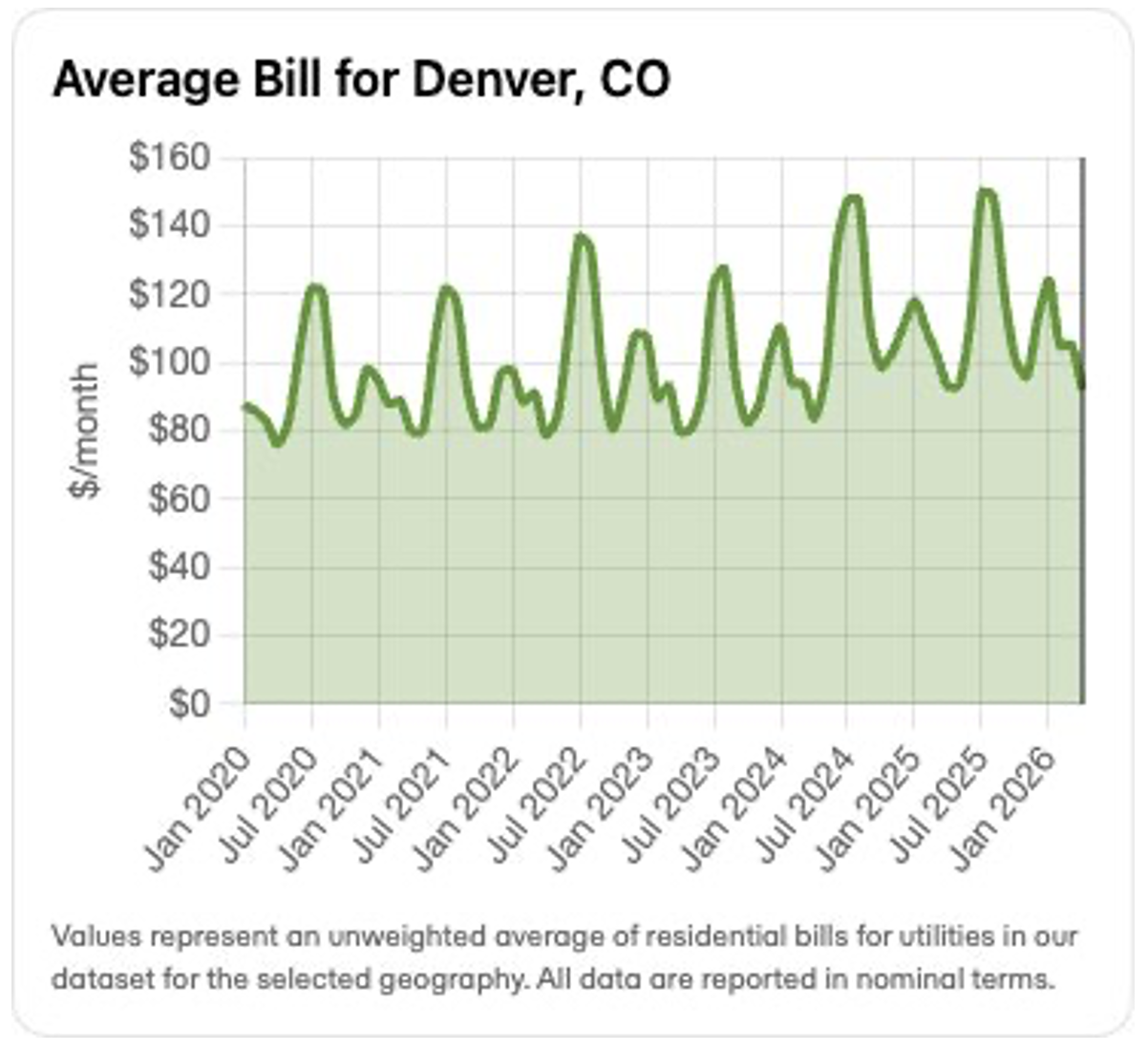
The power story in Colorado is evolving. Xcel Energy — the primary utility serving the Denver metro — has disclosed pending applications from data centers seeking 5.8 GW of electricity against a current generating capacity of 6.2 GW. In response, the Colorado Public Utilities Commission ordered Xcel to develop a large-load tariff for customers consuming more than 50 MW at peak, requiring them to fund their own infrastructure costs rather than distributing the burden to residential ratepayers. That tariff is pending PUC approval.
For most enterprise and regional colocation deployments — which typically fall well below the 50 MW threshold — power access and pricing at existing, fully energized facilities remains a meaningful cost advantage. The large-load tariff discussion is most relevant to hyperscale-scale developments seeking new utility interconnections.
On May 19, 2026, the Denver City Council voted unanimously to impose a one-year moratorium on new data center development within city limits, effective May 21, 2026 and set to expire in May 2027. The measure pauses the acceptance and processing of new zoning permits and site development plans for data centers while the city develops specific regulations governing energy consumption, water use, noise standards, and siting requirements.
The moratorium was driven primarily by community concerns over water consumption and the pace of development without regulatory guardrails. Denver currently has no zoning rules specific to data centers and no energy or water-use requirements for the facilities — the moratorium gives the city time to develop them. Already-permitted projects are not affected.
What this means for buyers: The moratorium constrains future new-build supply within Denver proper through at least May 2027. It does not affect capacity or operations at existing, permitted facilities. The working group process will determine whether Denver emerges with a clear, predictable permitting framework or more restrictive development standards. Organizations with near-term requirements should plan around current available inventory.
Community sentiment toward data center development in Denver County is more active than in many other U.S. markets. The concerns driving that engagement — water consumption, noise, visual impact, and development without community input — are the same factors that produced the moratorium. This is a feature of the current development environment, not a reason to discount the market.
Operators with established facilities, demonstrated track records, and existing community relationships are better positioned in this environment than new entrants seeking greenfield permits. The regulatory process underway may ultimately produce a clearer, more predictable framework for data center development in Denver — which would benefit the market long-term.
Despite the current regulatory moment, the underlying drivers that make Denver attractive have not changed:
1500 Champa Street | Denver, CO 80202
Radius DC operates a network-dense colocation facility at 1500 Champa Street in downtown Denver — a four-story, 138,116 sq ft building owned by Radius DC and served by Xcel Energy via the California substation. The facility is currently fully leased, reflecting the same supply constraints visible across the broader Denver market. Radius DC is actively evaluating expansion opportunities in the market; organizations with near- or medium-term capacity needs are encouraged to connect with our team to discuss waitlist options and future availability.
The following carriers and network providers are accessible within the Denver facility:
Radius DC is a data center platform built around two core assets: network-dense carrier hotels and purpose-built edge colocation campuses. The platform is designed to serve enterprises, digital platforms, network operators, and latency-sensitive workloads across growing metropolitan markets that are systematically underserved by the hyperscale-focused primary markets.
Radius DC currently has capacity across the following markets:
Whether you’re evaluating Denver for the first time or looking to expand your footprint in the Rocky Mountain region, our team can provide current availability details, connectivity specifics, and market guidance.
Connect with us at www.radius-dc.com/connect
Sources: CBRE North America Data Center Trends H1 & H2 2025; JLL North America Data Center Report Year-End 2025; Data Center Dynamics; Colorado Sun; Denver Gazette; Denverite; CPR News; 9NEWS Denver; Rocky Mountain PBS; Broadband Breakfast; Electricity data courtesy of WattBuy/public utility records. Market data as of May 2026.
© 2026 Radius DC. This report is provided for informational purposes only.
Jaymie Scotto & Associates (JSA)

.png)