
Platform
Locations
Insights and Resources
News
About
Connect
Client Portal
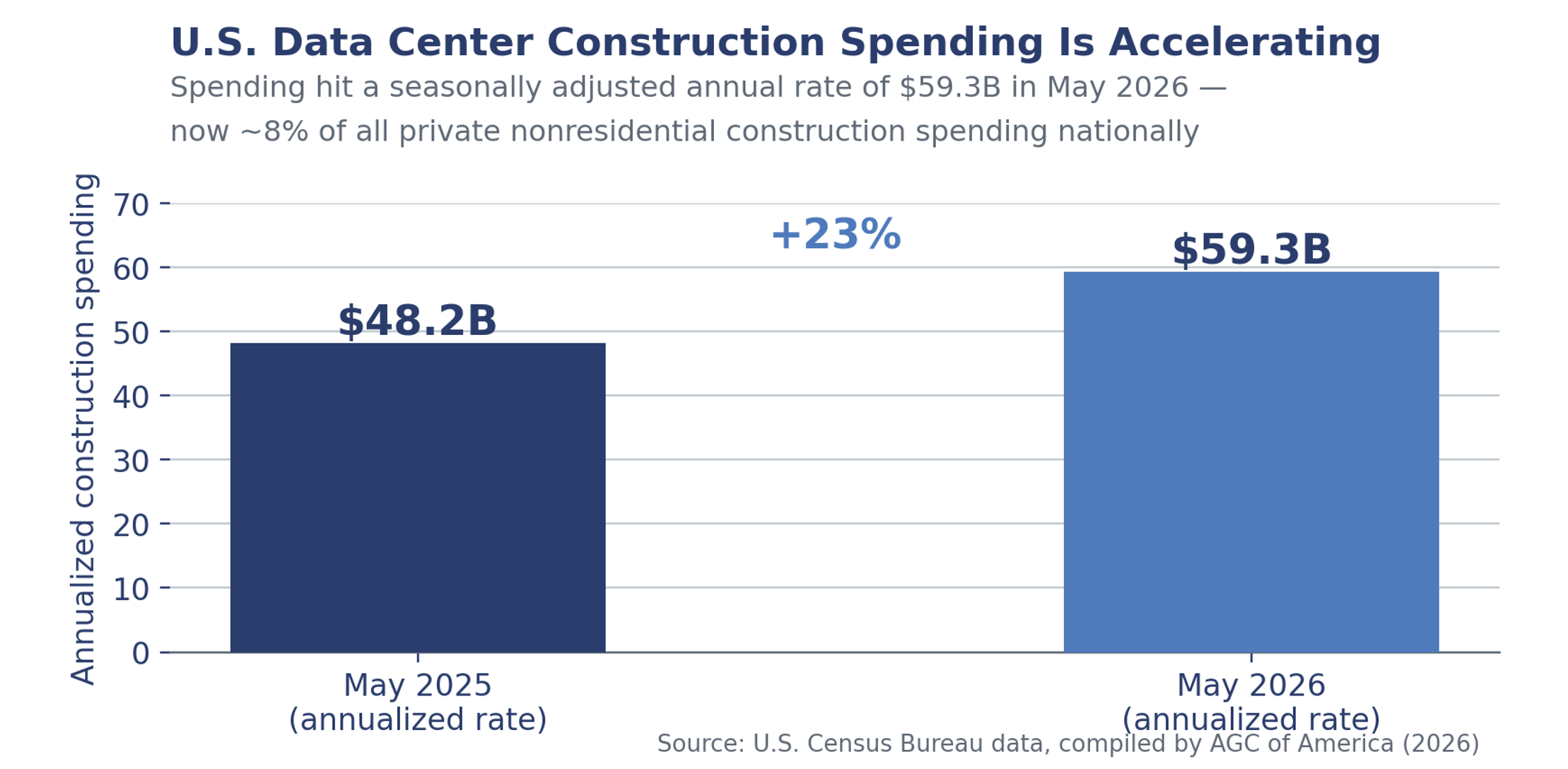
XData center construction has become one of the fastest-growing segments of nonresidential building in the United States. Spending on data center construction reached a seasonally adjusted annual rate of $59.3 billion in May 2026, up 23 percent from the year before, and data centers now account for roughly 8 percent of all private nonresidential construction spending nationally — a share that continues to grow, according to Census Bureau data compiled by the Associated General Contractors of America. That volume of building translates directly into local paychecks: construction workers nationally now earn roughly 20 percent more, on average, than private-sector workers overall, and wage growth in construction has been outpacing the broader private sector.
The scale of a single project can be significant. A 2025 comparative economic impact study of data center and manufacturing development in Ohio found that a single data center project could support nearly 9,700 construction jobs during the build phase, generate roughly $2.4 billion in total economic output, contribute about $1 billion to state GDP, and produce approximately $84 million in annual peak state and local tax revenue — all before the facility opens its doors, per AGC's data center economic impact research.
A data center build moves through distinct phases, and each one draws on a different part of the local trades workforce. Heavy-equipment operators and logistics crews prepare the site and coordinate materials first, followed by concrete workers, electricians, plumbers, and other skilled trades as vertical construction progresses — with electrical workers facing especially high demand given the density of power infrastructure involved, according to Fox News reporting on the blue-collar jobs boom tied to data centers.
A 2026 analysis by Anderson Economic Group, commissioned by Consumers Energy to evaluate data center scenarios across Michigan, put a finer point on the range: depending on project size, construction activity could support anywhere from roughly 800 to more than 30,000 direct and indirect jobs, with particularly strong demand for electricians, pipefitters, HVAC technicians, and heavy equipment operators, per Corp! Magazine's coverage of the study. Local heavy civil, excavation, grading, and concrete firms are seeing record backlogs as a result — mega-sites require intensive grading and specialized concrete pours engineered to support vibration-sensitive power equipment.
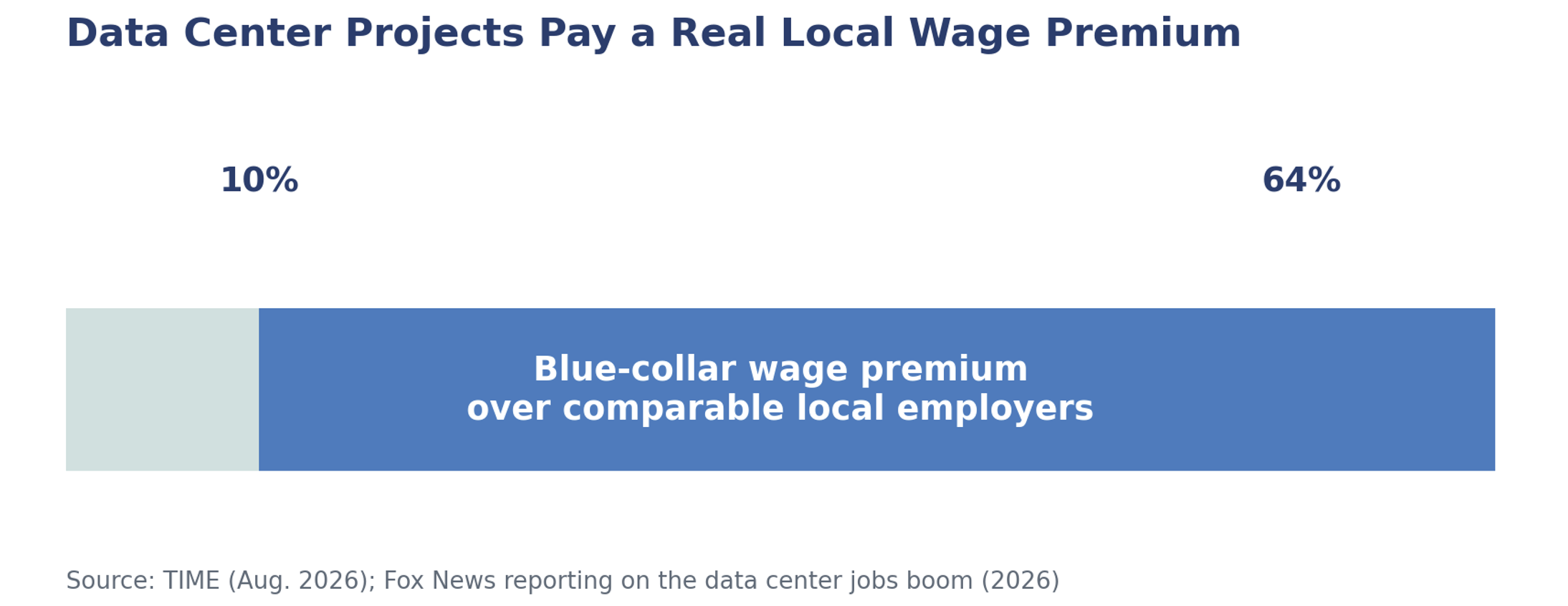
One of the more consequential ripple effects of this demand is wage growth. Data center projects have been paying blue-collar wage premiums of roughly 10 percent to 64 percent over comparable local employers, according to Time's 2026 reporting on data center site strategy — a premium substantial enough to ignite a genuine surge in technical college and apprenticeship enrollment in the markets where projects are landing.
That surge is already visible on the ground. In Virginia, Northern Virginia Community College's Equinix Digital Infrastructure Scholarship pairs a financial scholarship with mentoring and paid internships to move students directly into data center careers. In Mississippi, Hinds Community College's AWS pre-apprenticeship program offers a paid, four-week training course that leads to industry certifications and a direct pathway into the roughly 1,000 jobs tied to a nearby hyperscale investment. And in Maryland, Howard Community College's Catapult apprenticeship program, developed with AT&T, became the state's first IT registered apprenticeship and is now anchoring a new, county-funded Workforce Development and Trades Center built in part to meet growing digital infrastructure demand.
This is also creating room for entirely new categories of local business. Boutique firms focused on high-end physical security, mission-critical facility maintenance, and complex industrial safety monitoring are launching specifically to serve the specialized operational needs of data center campuses — work that didn't exist as a distinct local service category a decade ago.
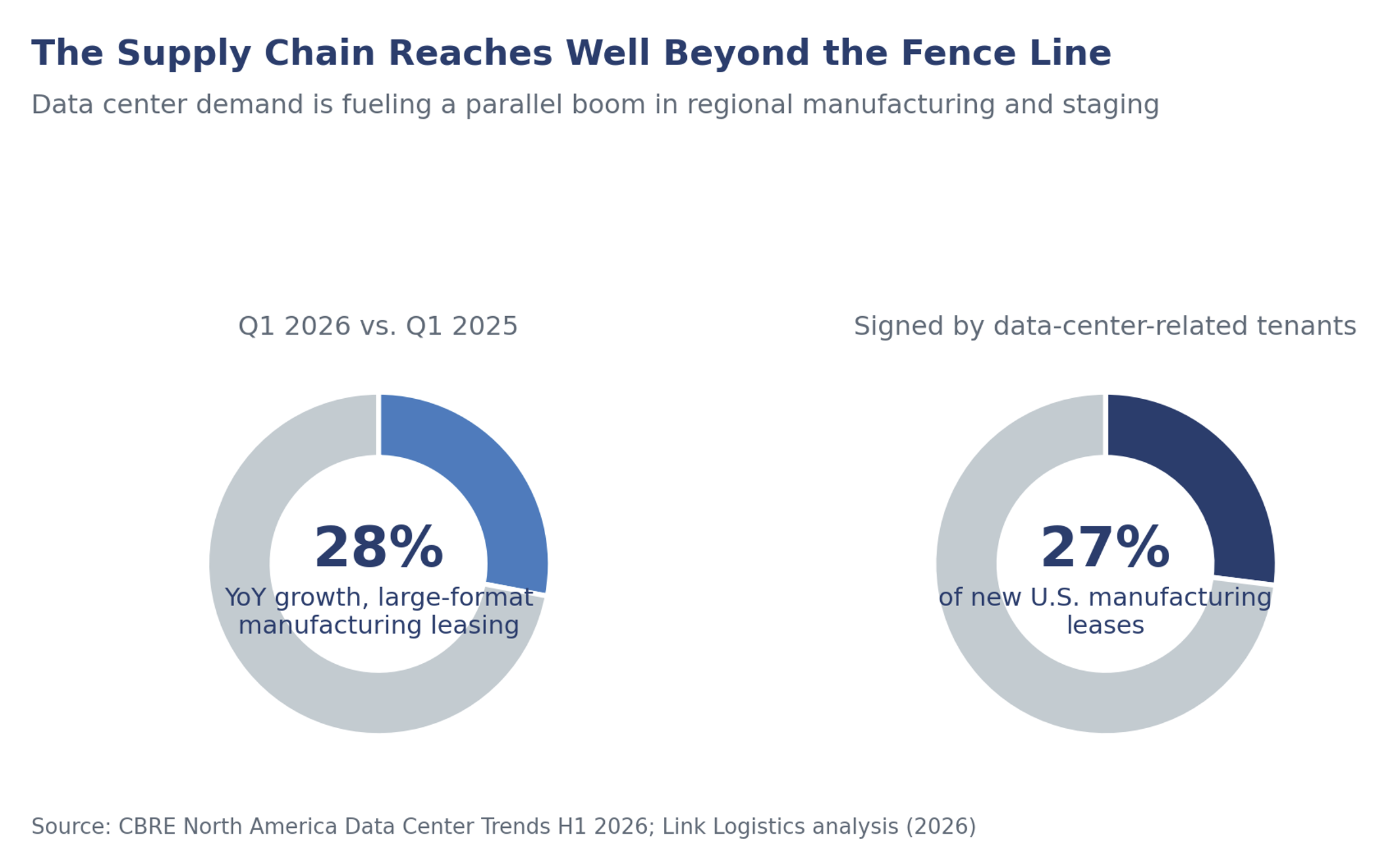
The economic footprint of a data center extends deep into regional manufacturing and logistics. Manufacturing leasing activity for facilities of 100,000 square feet or more rose 28 percent year-over-year in the first quarter of 2026, and manufacturers of data center and technology components accounted for the largest single share of that leasing activity, according to CBRE's North America Data Center Trends research. Separately, up to 27 percent of all new U.S. manufacturing leases signed are now taken by data-center-related tenants that use the space to stage, customize, and service hardware locally before it ever reaches the campus, per Link Logistics' analysis of warehouse demand.
Local and municipal telecom providers are expanding and consolidating to build out regional fiber footprints that connect new data center sites back to major internet backbones — infrastructure investment that benefits far more than the tenants inside any single facility, per CBRE. None of this depends on the facility filling every rack. It happens because a project is announced, sited, and built.
This growth is also proving durable rather than reckless. A landmark efficiency study published in the journal Science (Northwestern University, Lawrence Berkeley National Laboratory, and Koomey Analytics) found that between 2010 and 2018, even as global data center compute demand rose sixfold, worldwide data center energy use rose just 6 percent — as efficiency gains in servers, cooling, and virtualization absorbed the overwhelming majority of that growth. For the trades, suppliers, and municipalities investing alongside a new data center, that track record matters: the construction and supply chain activity underway today is building capacity for a sector whose demand growth is being managed responsibly, not one that is outrunning its own infrastructure.
As RadiusDC develops network-dense and purpose-built campuses across markets like Phoenix, Indianapolis, and Nashville, this same trades ecosystem — civil and grading contractors, electricians, mechanical and electrical suppliers, regional fiber providers — is part of how a project gets built, not an afterthought to it. Skilled labor demand, training pipelines, and supply chain activity are a real and immediate benefit a community can expect well before a single tenant moves in.
Construction jobs and trade activity are only half the picture, though. What a facility contributes back to a community over the long term — in tax revenue, public services, and the terms of the partnership itself — is where the more durable impact, and the more important questions, begin. That's the focus of the next piece in this series.
Radius DC operates carrier-neutral, purpose-built data centers in Phoenix, Miami, Denver, Atlanta, Nashville, and Indianapolis. Each facility is developed with deep interconnection ecosystems, scalable power infrastructure, and a disciplined approach to market selection — supporting enterprise, network, and hyperscale customers alongside the communities that host them.
Jaymie Scotto & Associates (JSA)

.png)