
Platform
Locations
Insights and Resources
News
About
Connect
Client Portal
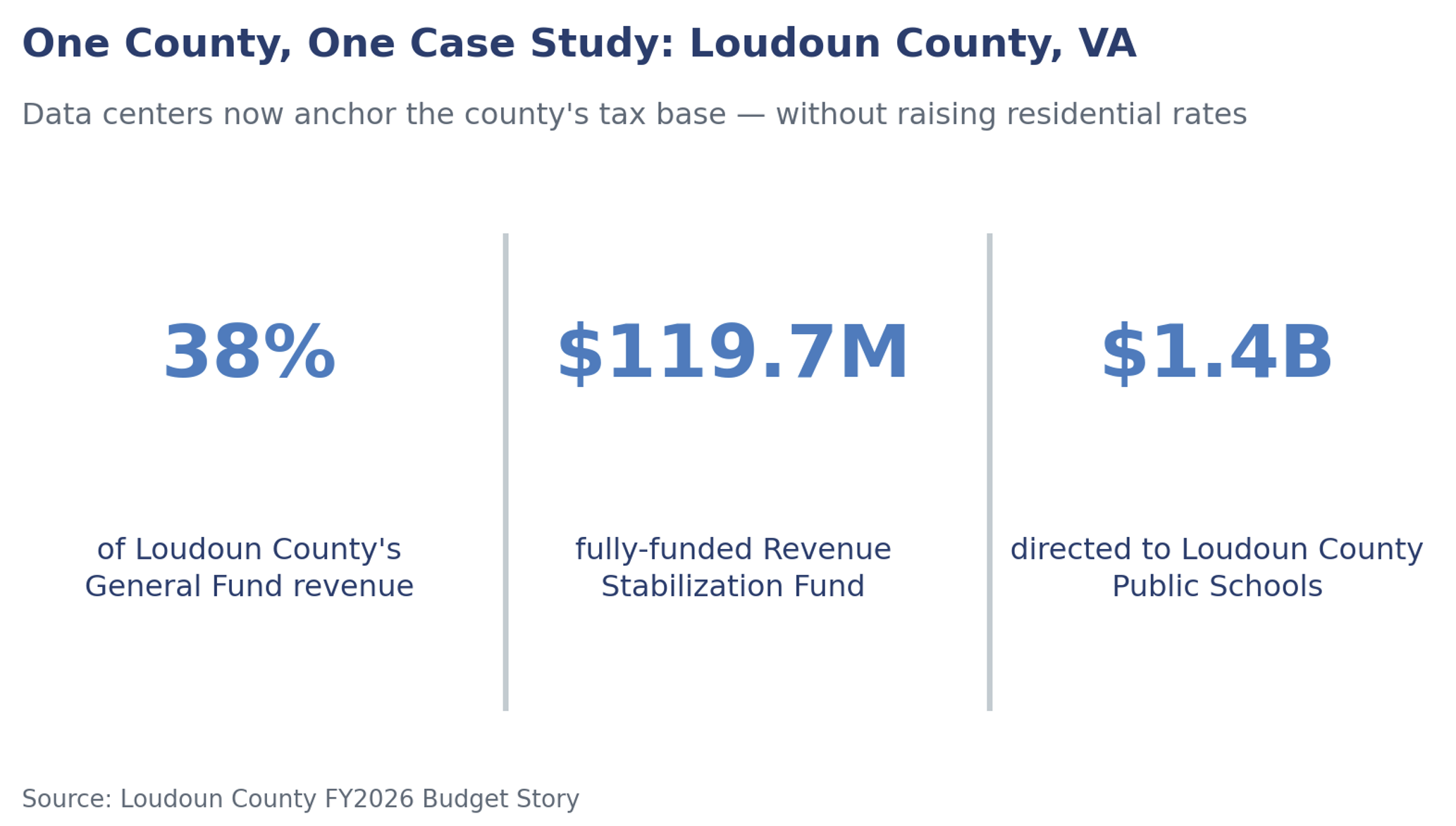
XData centers represent significant taxable property — servers, network and cooling equipment, and real estate — and in the counties where they've concentrated, that has translated into a genuinely structural shift in the local tax base. The clearest example is Loudoun County, Virginia, where data centers now generate 38 percent of the county's General Fund revenue, according to the county's FY 2026 Budget Story. That revenue funded a $119.7 million Revenue Stabilization Fund — now fully funded as of FY 2026 — and helped the county direct nearly $1.4 billion, almost half of its entire General Fund, to Loudoun County Public Schools, while keeping real property and vehicle tax rates among the lowest in the region. Separate reporting in August 2026 pegged the same dynamic at roughly 31 percent of all local tax revenue in the county — a different measure, but the same underlying story: data centers have become a structural pillar of the local fiscal base.
That impact isn't confined to one county. Virginia's Joint Legislative Audit and Review Commission has found that data centers statewide support roughly 74,000 jobs and contribute about $9.1 billion to the state's GDP, generating billions more in local revenue that funds education, public safety, and other core services, per reporting from The Register. More broadly, the Associated General Contractors of America notes that in some jurisdictions, data centers now account for up to approximately 30 percent of local tax revenue — and its 2025 Ohio impact study modeled roughly $84 million in annual peak state and local tax revenue from a single project.
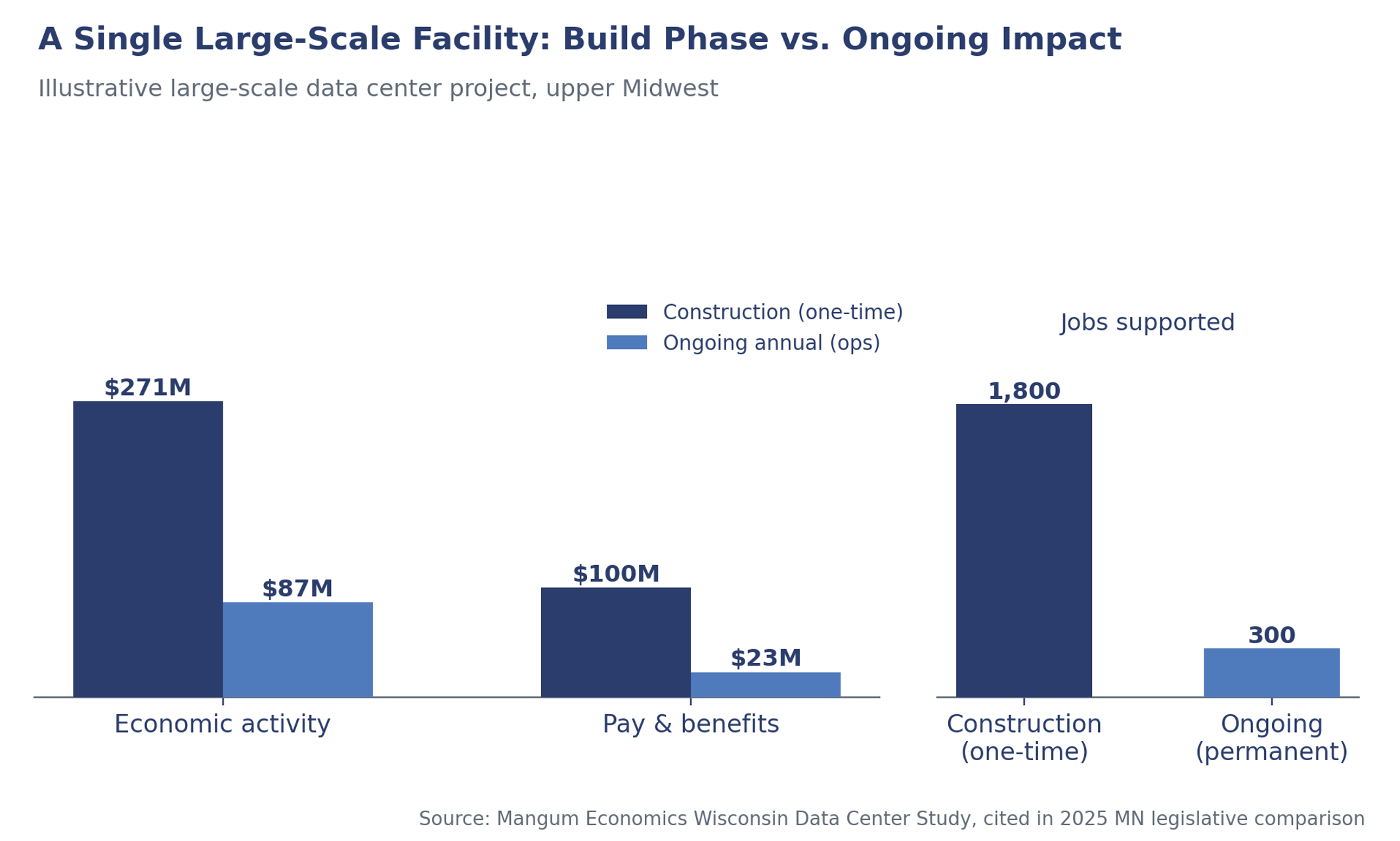
The scale of Loudoun County's numbers can make this look like a phenomenon reserved for the largest data center markets. It isn't. For rural counties and smaller municipalities, a single large-scale facility can meaningfully expand the local tax base and generate new funding for schools, roads, and public services. A widely cited economic study of a hypothetical large-scale data center in the upper Midwest — the 2022 Mangum Economics Wisconsin Data Center Study, referenced in a 2025 Minnesota legislative comparison — estimated that a new large-scale project could generate roughly $271 million in new economic activity and $100 million in pay and benefits across about 1,800 construction jobs during the build phase, followed by around $87 million in ongoing annual economic activity and $23 million in pay and benefits tied to roughly 300 permanent operations jobs.
None of this means every deal delivers the same return, and a fair accounting has to include the other side of the ledger. Many states offer sales and use tax exemptions on data center equipment to attract investment — in Virginia alone, those exemptions cost the state an estimated $1.6 billion in forgone tax revenue in fiscal 2025, more than double the prior year, according to Good Jobs First research cited by The Register. Critics in other states have raised similar concerns about incentive packages that offset a meaningful share of the fiscal upside, particularly when abatement periods delay when a community actually sees new revenue.
The honest conclusion isn't that the economic case for data centers is settled in either direction — it's that the net benefit to any given community depends almost entirely on how a specific project is structured: the size of any tax abatement, how long it lasts, what's negotiated in return, and how directly the revenue and jobs flow back to the community hosting the facility. That's precisely why the terms of a project, not just the headline investment figure, deserve real scrutiny before a community says yes.
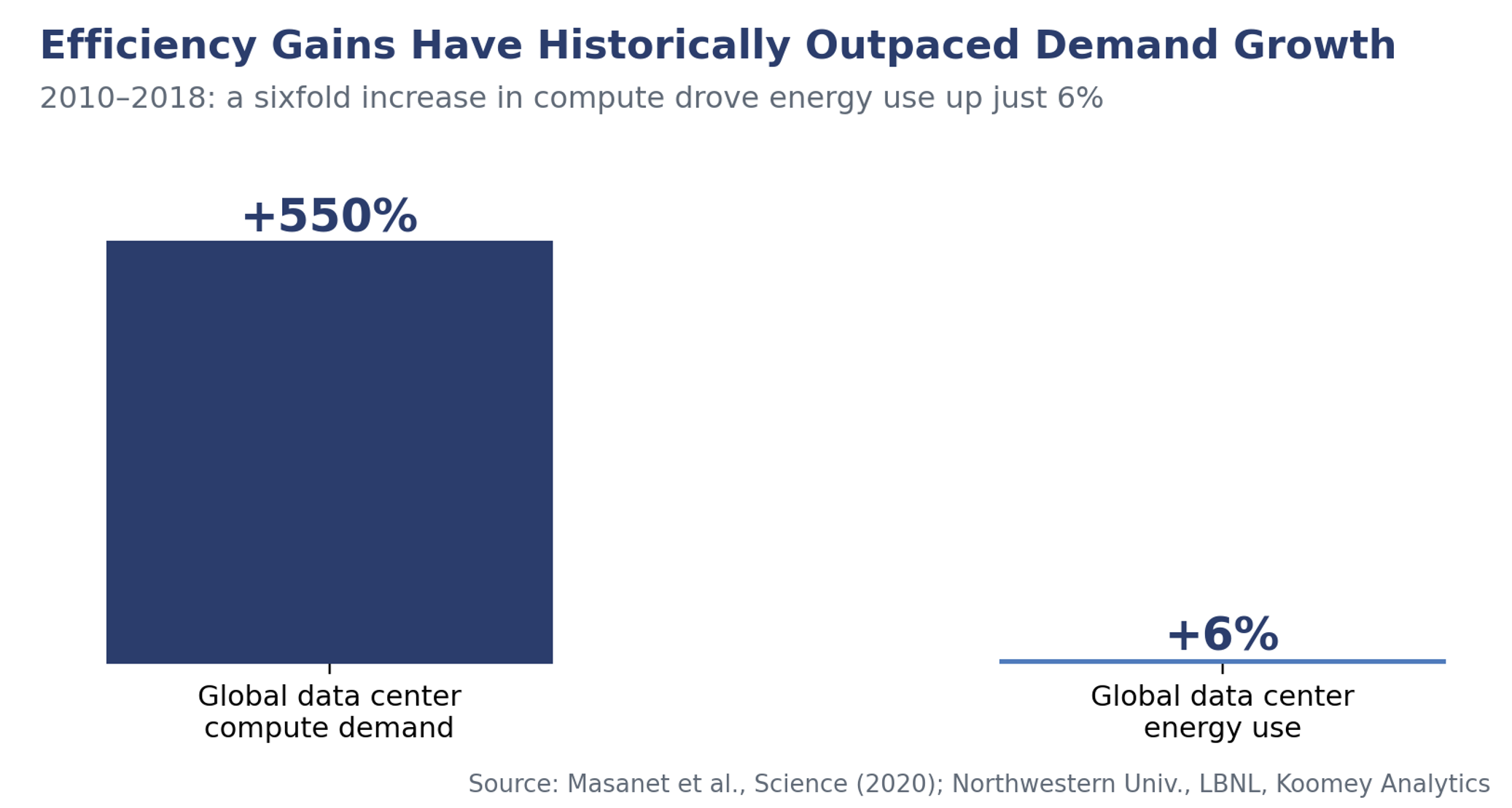
Electricity cost is consistently the single biggest driver of local resistance to new data center development, and that concern deserves a direct answer, not a dismissal. Part of that answer is historical: a landmark efficiency study published in the journal Science (Northwestern University, Lawrence Berkeley National Laboratory, and Koomey Analytics) found that between 2010 and 2018, global data center compute demand rose sixfold while worldwide data center energy use rose just 6 percent, as gains in server, cooling, and virtualization efficiency absorbed nearly all of that growth. That track record does not guarantee outcomes for any single community or eliminate the real, near-term load a large facility places on a local grid — but it does mean the fiscal upside documented above has not historically come at the cost of runaway community energy costs. It is also precisely why rate-neutrality and rebate structures, negotiated directly with utility regulators rather than left as a private matter between developer and utility, remain the single most effective lever a community has to make sure that stays true for its own project.
This is where community benefit agreements earn their keep. A well-structured agreement turns general goodwill into specific, trackable commitments — typically covering local hiring and apprenticeship pathways, operating limits on noise, water use, and generator testing, financial protections like decommissioning bonds and host community fees, and a named point of contact with a public process for tracking whether commitments are actually being met. In Van Buren Township, Michigan, Google committed $10 million to a community fund tied to its Project Cannoli data center — to be used at the community's discretion to address concerns like traffic, water use, and other project-related impacts.
The details matter more than the gesture. A specific, public water-use number lands differently than a general efficiency statement. A rate-neutrality or rebate structure negotiated with utility regulators reaches ratepayers in a way that a private agreement between a developer and a utility does not. A local-hire commitment carries more weight once it's been discussed directly with the building trades unions who will help fill it. And engagement that starts before a project is publicly disclosed shapes the terms of a deal in a way that engagement launched after the first contentious hearing simply cannot.
The economic upside of data center development is real, and it's substantial — skilled construction jobs, wage growth, expanded tax bases, and new funding for schools and public services are not hypothetical outcomes; they're documented in county budgets and independent economic studies across multiple states. But the size of that upside for any one community is not automatic. It's a function of deal structure, of how specific and enforceable the commitments are, and of whether the conversation started early enough for a community to actually help shape the outcome, rather than simply react to one.
For an asset-led, buyer-driven developer building in strategically selected metro markets, that means treating the economic case for a project as one part of a larger, ongoing conversation — not a one-time pitch. The developers who get this right aren't the ones with the biggest projected numbers. They're the ones willing to put those numbers, and the commitments attached to them, in writing.
Radius DC operates carrier-neutral, purpose-built data centers in Phoenix, Miami, Denver, Atlanta, Nashville, and Indianapolis. Each facility is developed with deep interconnection ecosystems, scalable power infrastructure, and a disciplined approach to market selection — supporting enterprise, network, and hyperscale customers alongside the communities that host them.
Jaymie Scotto & Associates (JSA)

.png)